Tournament blackjack: play the chips, not the hand.
Tournament blackjack isn’t won on long-term EV. It’s won on decisions: how much to bet with a few hands left, who you need to pass, and who can pass you.
Train at a full table where every bet and every play is graded by what it does to your chance of advancing, with chip EV beside it. Survive the bubble on purpose, not by luck.

Open now · Runs in your browser · Nothing to install
You are outside the advancing places and you sized down. A losing chip position needs variance, not preservation.
Every bet from 1,225 to 1,800 advances 44% of the time. Under 1,225 the chance falls away; at the minimum it is 24%.
Real figures from the trainer’s own engine: 20,000 simulated finishes for every bet size.
In play
The real table, on any screen.
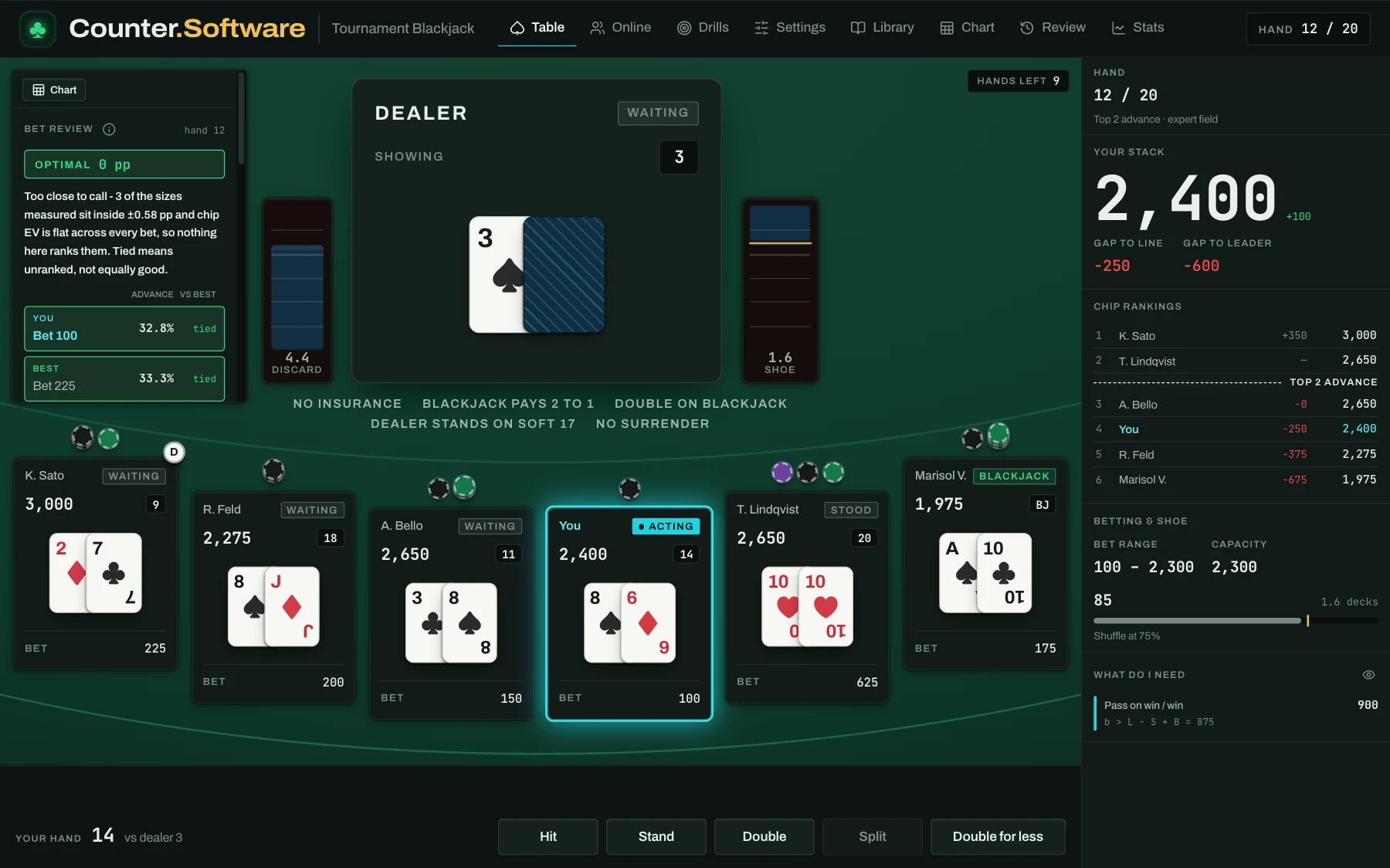
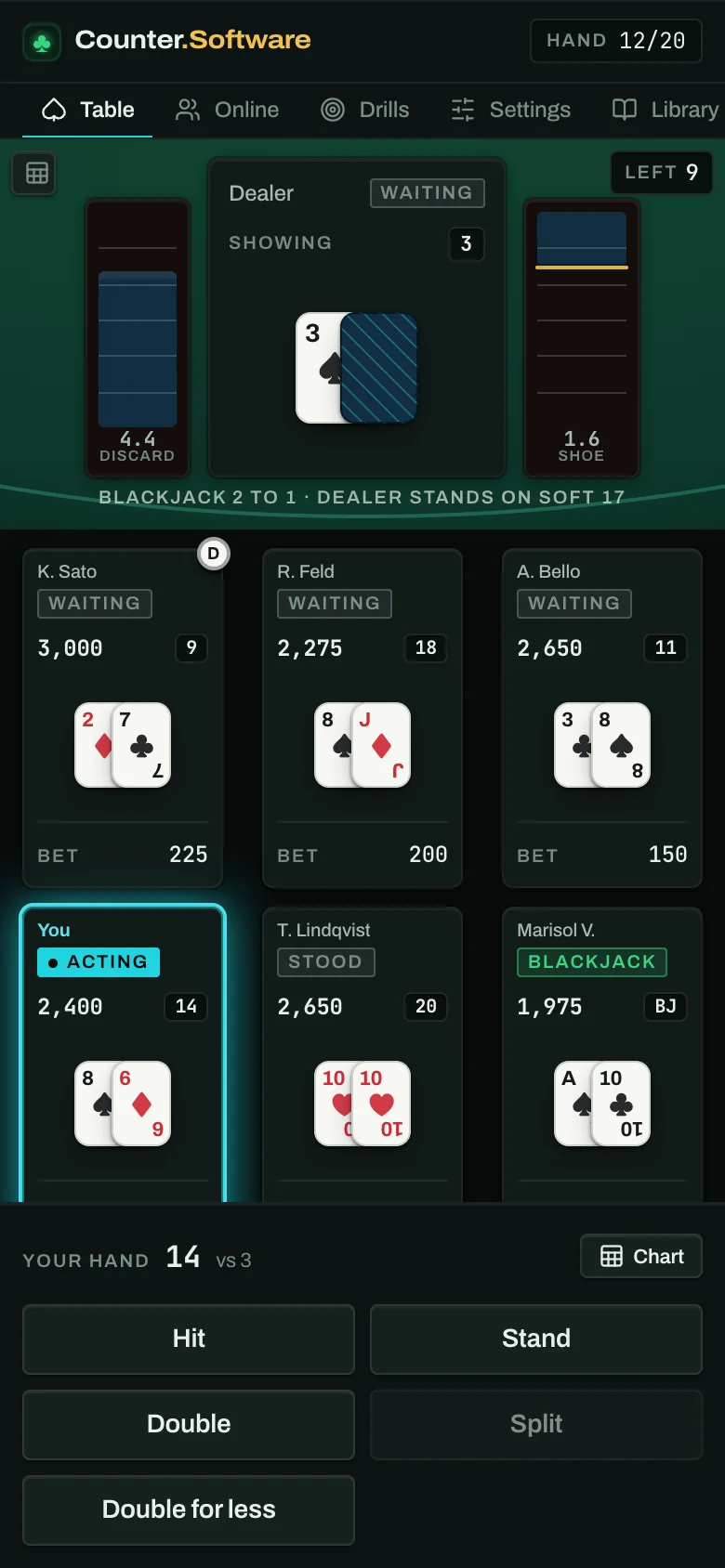
Hand 12 of 20. You’re fourth, 250 chips under the advance line, with 14 against the dealer’s 3. Around the hand: the whole field, what you need to pass, and your last bet, already graded.
Online multiplayer
Test yourself against your friends.
The same tournament round, live, with real people at the table: the ones you need to pass, and the ones who can pass you. Six seats, one shoe, one cut.
Bring your friends
Host a table with the hands, chips, bets and house rules you want, and send the link or the table’s code. All anyone needs to sit down is a name.
Or take on anyone
List your table under Open tables and anyone can join, or sit down at one yourself. Bots fill the empty seats and take over for anyone who leaves, and a 30-second clock keeps the table moving.
Graded, then ranked
When the round is over, every bet and play you made is graded, just as when you play alone. Rounds at standard tables go on your record and move your Elo rating: did you make the cut, weighed against everyone at the table, bots included. From your fifth, you’re on the shared leaderboard, ranked by rating.
Your tournament, your rules
Set the table you’re about to sit at.
Tournament rules change from room to room: the payout, the decks, soft 17, the hole card, surrender. Set the table and the structure you’re about to play, and every grade follows them.
Table rules
Structure and field
A preview of the trainer’s Settings. The real ones apply from your next round.
How you’re graded
Graded on the bet, not just the hand.
Priced in advancement
Every bet and every play is scored by the change in your chance of advancing, in percentage points, with chip EV beside it, so you see where the tournament answer and the cash-game answer part ways.
Five grades, honest about noise
Optimal, Fine, Inaccuracy, Mistake or Blunder, by the points of advancement a decision gave up. When the simulation can’t separate two options, the grade says so instead of inventing a winner.
A field that bets back
Three to seven seats bet in turn at the skill you set and play their hands by basic strategy - all but the experts, who play a round's last hand to win. The seats ahead of you have already bet when you act; the seats behind you see your bet.
The landscape
Every bet, priced in advancement.
Pick a spot. Each curve is the trainer’s own engine: your chance of advancing at every legal bet. Early in a round it slopes gently and the small bets are all alike. On the last hand it has cliffs, and they sit on chip thresholds you can learn to see.
Hover or drag across the chart to read any bet.
You’re 2nd with 2,250, 100 clear of 3rd, and you bet first. The minimum advances 28% of the time; 1,175 to 1,325, 49%, and from 1,375 up, 46.5%. Small is not safe here: the seat 100 behind you presses on this last hand and passes a small bet whenever it wins.
20,000 simulated finishes per bet size, the same seeds for every size. Expert field, six decks, dealer stands on soft 17, blackjack pays 2:1, no surrender, no maximum bet.
Everything inside
One engine. Every decision priced in advancement.
The table, the review, the drills and the library all run on the same engine that graded the spot above.
01 The grade
Graded by advancement, not chips
Every bet and every playing decision is scored by the change in your probability of advancing, in percentage points. Chip EV sits beside it, so you see exactly where the two part ways.
The bet landscape
Your chance of advancing across every legal bet, with your bet and the best one marked. The cliffs in it are chip thresholds: pass on a win, stay clear on a loss.
Every play ranked
The review lists each legal play with its chance to win the hand, its advancement, its distance from the best and its chip EV: hit, stand, double, double for less, split, surrender.
Honest about noise
When the simulation cannot separate two options, the grade says so instead of inventing a winner, and lists the plays inside the noise by exact chip EV.
02 Practice
Drills that move the stacks
Final hand, Last three hands, Turbo, Single round and Winner takes one. The short drills deal fresh stacks and a fresh seat in the betting order every rep, thresholds hidden.
Your costly spots, served back
The table keeps the decisions that cost you the most and deals them back as drills, with variations that move one thing, until you answer them with the chart closed.
The concept library
Fifteen named plays, from take the low and correlation bets to insurance as a lock and double for less to land exact, each measured by the engine.
The strategy chart
The chip-maximising play for every two-card hand, solved for your rules. Every tournament decision starts there, and the Library covers the spots where the standings overrule it.
03 At the table
Every branch spelled out
Win, push and lose, each with the stack and the place it leaves you, and what the seats around you would need to catch you.
Online tables
Play your friends, or whoever’s at an open table. Bots fill the empty seats, a 30-second clock keeps the table moving, and your grades arrive when the round is over. Rounds at standard tables count toward a shared leaderboard.
Round reports
A scorecard, your chip trail against the line, the three costliest lessons with a drill for each, the critical decisions, and the Hi-Lo count beside every grade.
Built for the phone too
Every screen has a phone layout. Double-tap your seat to enlarge it and keep playing; one tap puts it back.
Pricing
One trainer. Everything in it.
One purchase opens everything below, on every device you sign in on with your Counter.Software account.